Monday, 31 August 2015

Google now indexes SVG

Webmaster Level: All

You can now use Google search to find SVG documents. SVG is an open, XML-based format for vector graphics with support for interactive elements. We’re big fans of open standards, and our mission is to organize the world’s information, so indexing SVG is a natural step.

We index SVG content whether it is in a standalone file or embedded directly in HTML. The web is big, so it may take some time before we crawl and index most SVG files, but as of today you may start seeing them in your search results. If you want to see it yourself, try searching for [sitemap site:fastsvg.com] or [HideShow site:svg-whiz.com]

If you host SVG files and you wish to exclude them from Google’s search results, you can use the “X-Robots-Tag: noindex” directive in the HTTP header.

Check out Webmaster Central for a full list of file types we support.

How search results may differ based on accented characters and interface languages

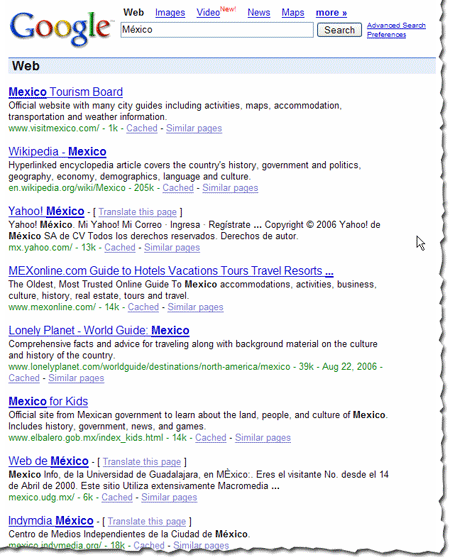
When a searcher enters a query that includes a word with accented characters, our algorithms consider web pages that contain versions of that word both with and without the accent. For instance, if a searcher enters [México], we'll return results for pages about both "Mexico" and "México."


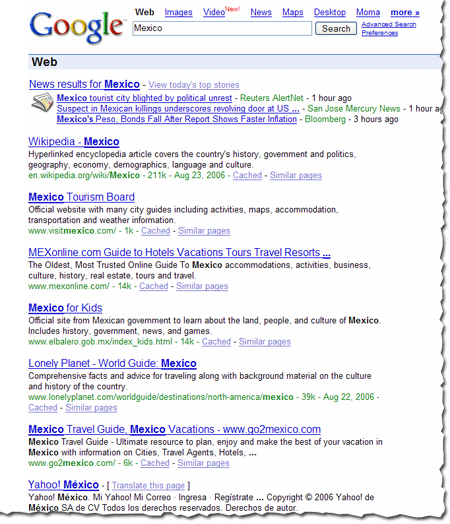
Conversely, if a searcher enters a query without using accented characters, but a word in that query could be spelled with them, our algorithms consider web pages with both the accented and non-accented versions of the word. So if a searcher enters [Mexico], we'll return results for pages about both "Mexico" and "México."


How the searcher's interface language comes into play
The searcher's interface language is taken into account during this process. For instance, the set of accented characters that are treated as equivalent to non-accented characters varies based on the searcher's interface language, as language-level rules for accenting differ.

Also, documents in the chosen interface language tend to be considered more relevant. If a searcher's interface language is English, our algorithms assume that the queries are in English and that the searcher prefers English language documents returned.

This means that the search results for the same query can vary depending on the language interface of the searcher. They can also vary depending on the location of the searcher (which is based on IP address) and if the searcher chooses to see results only from the specified language. If the searcher has personalized search enabled, that will also influence the search results.

The example below illustrates the results returned when a searcher queries [Mexico] with the interface language set to Spanish.


Note that when the interface language is set to Spanish, more results with accented characters are returned, even though the query didn't include the accented character.

How to restrict search results
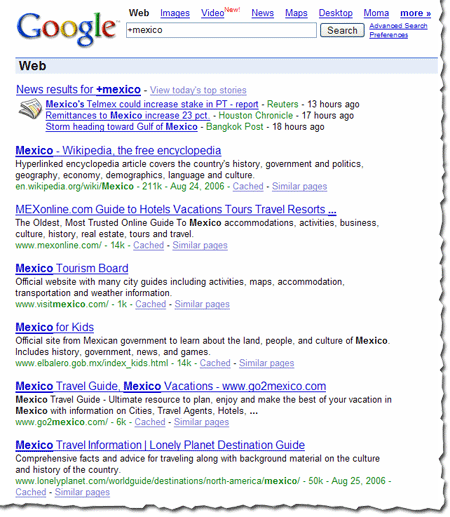
To obtain search results for only a specific version of the word (with or without accented characters), you can place a + before the word. For instance, the search [+Mexico] returns only pages about "Mexico" (and not "México"). The search [+México] returns only pages about "México" and not "Mexico." Note that you may see some search results that don't appear to use the version of word you specified in your query, but that version of the word may appear within the content of the page or in anchor text to the page, rather than in the title or description listed in the results. (You can see the top anchor text used to link to your site by choosing Statistics > Page analysis in webmaster tools.)

The example below illustrates the results returned when a searcher queries [+Mexico].

Sunday, 30 August 2015

Listen in - Matt Cutts and Vanessa Fox talk search

Tune into Webmaster Radio Thursday, August 31 at 1 pm Pacific to hear Matt Cutts and me take over GoodKarma while GoodROI (Greg Niland), the program's regular host, is on vacation. We'll talk about a little of everything, including giving Danny Sullivan career advice (if he ever decides to get out of search -- which we hope he never does -- he can always pursue a career in song), Google's handling of words with accented characters, display date changes in Google cached pages, and the not-so-nice side of SEO.

And if you missed last week's show, check out the podcast. Danny Sullivan and I explained that everything you need to know about search marketing, you can learn by watching Buffy the Vampire Slayer. If you heard the show and are worried about Danny's favorite espresso machine shop, don't be. They're doing OK after all.

Saturday, 29 August 2015

Update on penalty notifications


First, a brief recap: In late 2005, we started emailing webmasters to let them know that their site is violating our Webmaster Guidelines and that we have temporarily removed some of their pages from our index. A few months ago we put these emails on hold due to a number of spoofed messages being sent from outside Google, primarily to German webmasters. Then, in mid-July, we launched Message Center in our webmaster console, which allows us to send messages to verified site owners.

While Message Center is great for verified site owners, it doesn't allow us to notify webmasters who aren't registered in Google's Webmaster Tools. For this reason, we plan to resume sending emails in addition to the Message Center notifications. Please note that, as before, our emails will not include attachments. Currently, the Message Center won't keep messages waiting if you haven't previously registered, but we hope to add that feature in the next few months. We'll keep you posted as things change.

Site Errors Breakdown

Webmaster level: All

Today we’re announcing more detailed Site Error information in Webmaster Tools. This information is useful when looking for the source of your Site Errors. For example, if your site suffers from server connectivity problems, your server may simply be misconfigured; then again, it could also be completely unavailable!  Since each Site Error (DNS, Server Connectivity, and Robots.txt Fetch) is comprised of several unique issues, we’ve broken down each category into more specific errors to provide you with a better analysis of your site’s health.

Site Errors will display statistics for each of your site-wide crawl errors from the past 90 days.  In addition, it will show the failure rates for any category-specific errors that have been affecting your site.


If you’re not sure what a particular error means, you can read a short description of it by hovering over its entry in the legend.  You can find more detailed information by following the “More info” link in the tooltip.


We hope that these changes will make Site Errors even more informative and helpful in keeping your site in tip-top shape.  If you have any questions or suggestions, please let us know through the Webmaster Tools Help Forum.

Thursday, 27 August 2015

Register non-English domain names with Webmaster Tools


I'm happy to announce that Webmaster Tools is expanding support for webmasters outside of the English-speaking world, by supporting Internationalizing Domain Names in Applications (IDNA). IDNA provides a way for site owners to have domains that go beyond the domain name system's limitations of English letters and numbers. Prior to IDNA, Internet host names could only be in the 26 letters of the English alphabet, the numbers 0-9, and the hyphen character. With IDNA support, you'll now be able to add your sites that use other character sets, and organize them easily on your Webmaster Tools Dashboard.

Let's say you wanted to add http://北京大学.cn/ (Peking University) to your Webmaster Tools account before we launched IDNA support. If you typed that in to the "Add Site" box, you'd get back an error message that looks like this:


Some webmasters discovered a workaround. Internally, IDNA converts nicely encoded http://北京大学.cn/ to a format called Punycode, which looks like http://xn--1lq90ic7fzpc.cn/. This allowed them to diagnose and view information about their site, but it looked pretty ugly. Also, if they had more than one IDNA site, you can imagine it would be pretty hard to tell them apart.


Since we now support IDNA throughout Webmaster Tools, all you need to do is type in the name of your site, and we will add it correctly. Here is what it looks like if you attempt to add http://北京大学.cn/ to your account:


If you are one of the webmasters who discovered the workaround previously (i.e., you have had sites listed in your account that look like http://xn--1lq90ic7fzpc.cn/), those sites will now automatically display correctly.

We'd love to hear your questions and feedback on this new feature; you can write a comment below or post in the Google Webmaster Tools section of our Webmaster Help Group. We'd also appreciate suggestions for other ways we can improve our international support.

Monday, 24 August 2015

ZTE V970 (Dual SIM with 3G support)

Introduction

Approximately one month after MediaTek's official launch of the new MT6577 platform, the first devices based on that same chipset started to emerge...

The usual replicas of the hottest smartphones available on the market will always continue to appear, but also big Chinese companies are betting hard on MediaTek platforms. Lenovo is a great example of that, with some successful models such as A60 (MT6573), A750 (MT6575) and the most recently released A789 (MT6577).

Another known Chinese manufacturer choosing MediaTek platforms to power its devices is ZTE. By 2014, ZTE was the world's fifth-largest telecommunications equipment maker measured by its revenues and the world's fourth-largest mobile phone manufacturer measured by unit sales. This review will cover details about the newly released ZTE V970, a dual SIM smartphone based on MT6577 chipset.

Specifications

Chipset

Name:MediaTek MT6577
CPU:Dual-core 1 GHz ARM Cortex™-A9
GPU:PowerVR™ SGX 531
Instruction set:ARMv7

Software environment

Embedded:OS: Android 4.0.4 (Ice Cream Sandwich)

Body

Dimensions
(width x height x depth):
127.4 x 65 x 9.9 millimetres
Weigth:140 grams (battery included)
Color:Black

Battery

Capacity: 1600 mAh

Memory

RAM:capacity:1 GB
ROM-capacity:4 GB
Expansion slot:microSD memory card, supporting up to 64 GB

Network support

Primary phone:GSM850, GSM900, GSM1800, GSM1900, UMTS900, UMTS2100
Secondary phone:GSM850, GSM900, GSM1800, GSM1900
Data links:GPRS, EDGE, HSDPA, HSUPA

Display

Type:IPS-LCD capacitive touchscreen
Size:4.3 inches, qHD resolution (540 x 960 pixels)

Camera

Main (rear):5 megapixels with autofocus and single LED flash
Secondary (front):None

Interfaces

Bluetooth (802.15):Bluetooth 3.0 + Enhanced Data Rate
Wireless LAN / Wi-Fi (802.11):  IEEE 802.11b, IEEE 802.11g, IEEE 802.11n
USB:USB 2.0 Client, Hi-Speed (480 Mbit/s)
USB Series Micro-B (Micro-USB) connector

Satellite navigation

Built-in GPS module:MT6620 chipset
GPS antenna:Internal
Complementary GPS services:  MediaTek EPO (Extended Prediction Orbit)

Additional features

Sensors:Gravity, Proximity and Light sensors
Analog Radio:FM radio (87.5-108 MHz) with RDS radio receiver
Others:Dedicated LED for notification of missed calls / new messages

Design and construction

The overall design of V970 is relatively sleek, resembling the Nexus S in its preference for slimness and rounded corners. The outer bezel around the display is made of metallic plastic while the back cover is made of a textured rubbery which provides good, solid grip and a nice feel when holding the phone.


There are four Android touch-keys on the bezel  –  Menu, Home, Back and Search. The buttons are illuminated by a backlight when the screen is turned on.


On the top left corner, it is placed the usual power charging LED (red colored). But in addition to that, there is also a green LED that becomes permanently lit when the battery is fully charged and also blinks as form of notification of eventual missed calls / new messages received.

The volume rocker is placed on the top left edge while the microUSB port is located further bellow.


The 3,5 mm headset jack and power button are located on the top edge.


On the back side, there's a 5 megapixels autofocus camera placed left to a single LED flash.


Placed in the lower-left corner, there is a small notch that allows you to peel off the rear cover, providing access to the SIM card slots, battery and microSD card slot.


The fact that you can access this memory expansion slot without removing the battery isn't just a matter of convenience - V970 lets you hot swap microSD memory. That means you can remove and replace memory without turning the handset off, much like you would on a computer.

Display quality

The phone features a IPS-LCD. Its 540 x 960 resolution and 4.3 inches diagonal are in line with the HTC One S, and while the 256ppi density means it doesn't approach retina display levels, it's still extremely sharp.


Functionality

This phone comes pre-installed with Android 4.0.4. It makes no sense to detail the features all over again taking into consideration that the framework from MediaTek hasn't changed much from the previous Android 4.0.3 builds. So, I'll leave here just a few screenshots and deeper details can be found under ZOPO ZP300 functionality review as the same applies to V970.


The phone supports quad-band GSM as well as UMTS 900 MHz and 2100 MHz as confirmed under hidden MTK Engineer Mode.


The stock ROM from ZTE doesn't provide access to Google services, but that situation can be easily overcome by installing the latest version of Google apps.


Final thoughts

I'm very impressed with V970 and must say that it is actually one of the best dual SIM smartphones I have ever had, leaving behind the memories of my "good old" G11i Pro.

This phone can be bought from etotalk.comZTE V970 is now available for 205.99 USD.

Highs:
  • High quality product from one of the world's biggest mobile phone manufacturers
  • Very good performance
Lows:
  • Lack of front camera

Sunday, 23 August 2015

System maintenance

We're currently doing routine system maintenance, and some data may not be available in your webmaster tools account today. We're working as quickly as possible, and all information should be available again by Thursday, 8/24. Thank you for your patience in the meantime.

Update: We're still finishing some things up, so thanks for bearing with us. Note that the preferred domain feature is currently unavailable, but will available as soon as our maintenance is complete.

Friday, 21 August 2015

rel=”author” frequently asked (advanced) questions

Webmaster Level: Intermediate to Advanced

Using authorship helps searchers discover great information by highlighting content from authors who they might find interesting. If you’re an author, signing up for authorship will help users recognize content that you’ve written. Additionally, searchers can click the byline to see more articles you’ve authored or to follow you on Google+. It’s that simple! Well, except for several advanced questions that we’d like to help answer...


Authorship featured in search results from one of my favorite authors, John Mueller


Clicking the author’s byline in search results can reveal more articles and a Google+ profile

Recent authorship questions

1. What kind of pages can be used with authorship?
Good question! You can increase the likelihood that we show authorship for your site by only using authorship markup on pages that meet these criteria:
  • The URL/page contains a single article (or subsequent versions of the article) or single piece of content, by the same author. This means that the page isn’t a list of articles or an updating feed. If the author frequently switches on the page, then the annotation is no longer helpful to searchers and is less likely to be featured.
  • The URL/page consists primarily of content written by the author.
  • Showing a clear byline on the page, stating the author wrote the article and using the same name as used on their Google+ profile.
2. Can I use a company mascot as an author and have authorship annotation in search results? For my pest control business, I’d like to write as the “Pied Piper.”
You’re free to write articles in the manner you prefer -- your users may really like the Pied Piper idea. However, for authorship annotation in search results, Google prefers to feature a human who wrote the content. By doing so, authorship annotation better indicates that a search result is the perspective of a person, and this helps add credibility for searchers.

Again, because currently we want to feature people, link authorship markup to an individual’s profile rather than linking to a company’s Google+ Page.
3. If I use authorship on articles available in different languages, such as
example.com/en/article1.html for English and
example.com/fr/article1.html for the French translation,
should I link to two separate author/Google+ profiles written in each language?

In your scenario, both articles:
example.com/en/article1.html
and
example.com/fr/article1.html
should link to the same Google+ profile in the author’s language of choice.
4. Is it possible to add two authors for one article?
In the current search user interface, we only support one author per article, blog post, etc. We’re still experimenting to find the optimal outcome for searchers when more than one author is specified.
5. How can I prevent Google from showing authorship?
The fastest way to prevent authorship annotation is to make the author’s Google+ profile not discoverable in search results. Otherwise, if you still want to keep your profile in search results, then you can remove any profile or contributor links to the website, or remove the markup so that it no longer connects with your profile.
6. What’s the difference between rel=author vs rel=publisher?
rel=publisher helps a business create a shared identity by linking the business’ website (often from the homepage) to the business’ Google+ Page. rel=author helps individuals (authors!) associate their individual articles from a URL or website to their Google+ profile. While rel=author and rel=publisher are both link relationships, they’re actually completely independent of one another.
7. Can I use authorship on my site’s property listings or product pages since one of my employees has customized the description?
Authorship annotation is useful to searchers because it signals that a page conveys a real person’s perspective or analysis on a topic. Since property listings and product pages are less perspective/analysis oriented, we discourage using authorship in these cases. However, an article about products that provides helpful commentary, such as, “Camera X vs. Camera Y: Faceoff in the Arizona Desert” could have authorship.
If you have additional questions, don’t forget to check out (and even post your question if you don’t see it covered :) in the Webmaster Forum.

Thursday, 20 August 2015

Search Queries Alerts in Webmaster Tools

Webmaster level: All

We know many of you check Webmaster Tools daily (thank you!), but not everybody has the time to monitor the health of their site 24/7. It can be time consuming to analyze all the data and identify the most important issues. To make it a little bit easier we’ve been incorporating alerts into Webmaster Tools. We process the data for your site and try to detect the events that could be most interesting for you. Recently we rolled out alerts for Crawl Errors and today we’re introducing  alerts for Search Queries data.

The Search Queries feature in Webmaster Tools shows, among other things, impressions and clicks for your top pages over time. For most sites, these numbers follow regular patterns, so when sudden spikes or drops occur, it can make sense to look into what caused them. Some changes are due to differing demand for your content, other times they may be due to technical issues that need to be resolved, such as broken redirects. For example, a steady stream of clicks which suddenly drops to zero is probably worth investigating.

The alerts look like this:


We’re still working on the sensitivity threshold of the messages and welcome your feedback in our help forums. We hope the new alerts will be useful. Don’t forget to sign up for email forwarding to receive them in your inbox.


Showing more results from a domain

Webmaster Level: All

Today we’ve launched a change to our ranking algorithm that will make it much easier for users to find a large number of results from a single site. For queries that indicate a strong user interest in a particular domain, like [exhibitions at amnh], we’ll now show more results from the relevant site:


Prior to today’s change, only two results from www.amnh.org would have appeared for this query. Now, we determine that the user is likely interested in the Museum of Natural History’s website, so seven results from the amnh.org domain appear. Since the user is looking for exhibitions at the museum, it’s far more likely that they’ll find what they’re looking for, faster. The last few results for this query are from other sites, preserving some diversity in the results.

We’re always reassessing our ranking and user interface, making hundreds of changes each year. We expect today’s improvement will help users find deeper results from a single site, while still providing diversity on the results page.


Wednesday, 19 August 2015

All About Googlebot

I've seen a lot of questions lately about robots.txt files and Googlebot's behavior. Last week at SES, I spoke on a new panel called the Bot Obedience course. And a few days ago, some other Googlers and I fielded questions on the WebmasterWorld forums. Here are some of the questions we got:

If my site is down for maintenance, how can I tell Googlebot to come back later rather than to index the "down for maintenance" page?
You should configure your server to return a status of 503 (network unavailable) rather than 200 (successful). That lets Googlebot know to try the pages again later.

What should I do if Googlebot is crawling my site too much?
You can contact us -- we'll work with you to make sure we don't overwhelm your server's bandwidth. We're experimenting with a feature in our webmaster tools for you to provide input on your crawl rate, and have gotten great feedback so far, so we hope to offer it to everyone soon.

Is it better to use the meta robots tag or a robots.txt file?
Googlebot obeys either, but meta tags apply to single pages only. If you have a number of pages you want to exclude from crawling, you can structure your site in such a way that you can easily use a robots.txt file to block those pages (for instance, put the pages into a single directory).

If my robots.txt file contains a directive for all bots as well as a specific directive for Googlebot, how does Googlebot interpret the line addressed to all bots?
If your robots.txt file contains a generic or weak directive plus a directive specifically for Googlebot, Googlebot obeys the lines specifically directed at it.

For instance, for this robots.txt file:
User-agent: *
Disallow: /

User-agent: Googlebot
Disallow: /cgi-bin/
Googlebot will crawl everything in the site other than pages in the cgi-bin directory.

For this robots.txt file:
User-agent: *
Disallow: /
Googlebot won't crawl any pages of the site.

If you're not sure how Googlebot will interpret your robots.txt file, you can use our robots.txt analysis tool to test it. You can also test how Googlebot will interpret changes to the file.

For complete information on how Googlebot and Google's other user agents treat robots.txt files, see our webmaster help center.

Tuesday, 18 August 2015

Verification time savers —  Analytics included!

Webmaster Level: All

Nobody likes to duplicate effort. Unfortunately, sometimes it's a fact of life. If you want to use Google Analytics, you need to add a JavaScript tracking code to your pages. When you're ready to verify ownership of your site in other Google products (such as Webmaster Tools), you have to add a meta tag, HTML file or DNS record to your site. They're very similar tasks, but also completely independent. Until today.

You can now use a Google Analytics JavaScript snippet to verify ownership of your website. If you already have Google Analytics set up, verifying ownership is as simple as clicking a button.


This only works with the newer asynchronous Analytics JavaScript, so if you haven't migrated yet, now is a great time. If you haven't set up Google Analytics or verified yet, go ahead and set up Google Analytics first, then come verify ownership of your site. It'll save you a little time — who doesn't like that? Just as with all of our other verification methods, the Google Analytics JavaScript needs to stay in place on your site, or your verification will expire. You also need to remain an administrator on the Google Analytics account associated with the JavaScript snippet.

Don't forget that once you've verified ownership, you can add other verified owners quickly and easily through the Verification Details page. There's no need for each owner to manually verify ownership. More effort and time saved!


We've also introduced an improved interface for verification. The new verification page gives you more information about each verification method. In some cases, we can now provide detailed instructions about how to complete verification with your specific domain registrar or provider. If your provider is included, there's no need to dig through their documentation to figure out how to add a verification DNS record — we'll walk you through it.


The time you save using these new verification features might not be enough to let you take up a new hobby, but we hope it makes the verification process a little bit more pleasant. As always, please visit the Webmaster Help Forum if you have any questions.

Monday, 17 August 2015

Join us at cool SES San Jose - it'll be hot!


As summer inches towards fall and in many places the temperature is still rising, you're probably thinking the best place to be right now is on the beach, by a pool or inside somewhere that's air-conditioned. These are all good choices, but next week there's somewhere else to be that's both hot and cool: the Search Engines Strategies conference in San Jose. In addition to the many tantalizing conference sessions covering diverse topics related to search, there will be refreshments, food, and of course, air-conditioning.
Googlers attending SES San Jose
Additionally, on Tuesday evening at our Mountain View ‘plex we're hosting the “Google Dance” -- where conference attendees can eat, drink, play, dance, and talk about search. During the Google Dance be sure to attend the “Meet the Engineers” event where you’ll be able to meet and have a conversation with 25 or more engineers including Webmaster Central’s own Amanda Camp. Also, if you get a spare minute from merry-making, head over to the Webmaster Tools booth, where you’ll find Maile Ohye offering lots of good advice.

If you’re a night owl, you’ll probably also be interested in the unofficial late-night SES after-parties that you only know about if you talk to the right person. To stem the potential barrage of “where’s the party” questions, I'd like to make it clear that I unfortunately am not the right person. But if you happen to be someone who’s organizing a late night party, please consider inviting me. ;)

"Enough about the parties -- what about the conference?," you ask. As you would expect, Google will be well-represented at the conference. Here is a sampling of the Search-related sessions at which Googlers will be speaking:

Universal & Blended Search
Monday, August 20
11:00am-12:30pm
David Baile

Personalization, User Data & Search
Monday, August 20
2:00 - 3:30pm
Sep Kamvar

Searcher Behavior Research Update
Monday, August 20
4:00 - 5:30pm
Oliver Deighton

Are Paid Links Evil?
Tuesday, August 21
4:45 - 6:00pm
Matt Cutts

Keynote Conversation
Wednesday, August 22
9:00 - 9:45am
Marissa Mayer

Search APIs
Wednesday, August 22
10:30am - 12:00pm
Jon Diorio

SEO Through Blogs & Feeds
Wednesday, August 22
10:30am - 12:00pm
Rick Klau

Duplicate Content & Multiple Site Issues
Wednesday, August 22
1:30 - 2:45pm
Greg Grothaus

CSS, AJAX, Web 2.0 & Search Engines
Wednesday, August 22
3:15 - 4:30pm
Amanda Camp

Search Engine Q&A On Links
Wednesday, August 22
4:45 - 6:00pm
Shashi Thakur

Meet the Crawlers
Thursday, August 23
10:45am - 12:00pm
Evan Roseman

We will also have a large presence in the conference expo hall where members of the Webmaster Central Team like Susan Moskwa and I will be present at the Webmaster Tools booth to answer questions, listen to your thoughts and generally be there to chat about all things webmaster related. Bergy and Wysz, two more of us who tackle tough questions in the Webmaster Help Groups, will be offering assistance at the Google booth (live and in person, not via discussion thread).

If you're reading this and thinking, "I should go and grab the last frozen juice bar in the freezer," I suggest that you save that frozen juice bar for when you return from the conference and find that your brain's overheating from employing all the strategies you've learned and networking with all the people you've met.

Joking aside, we are psyched about the conference and hope to see you there. Save a cold beverage for me!

Sunday, 16 August 2015

To err is human, Video Sitemap feedback is divine!

Webmaster Level: All

You can now check your Video Sitemap for even more errors right in Webmaster Tools! It’s a new Labs feature to signal issues in your Video Sitemap such as:
  • URLs disallowed by robots.txt
  • Thumbnail size errors (160x120px is ideal. Anything smaller than 90x50 will be rejected.)


Video Sitemaps help us to better crawl and extract information about your videos, so we can appropriately feature them in search results.

Totally new to Video Sitemaps? Check out the Video Sitemaps center for more information. Otherwise, take a look at this new Labs feature in Webmaster Tools.

Back from SES San Jose

Thanks to everyone who stopped by to say hi at the Search Engine Strategies conference in San Jose last week!

I had a great time meeting people and talking about our new webmaster tools. I got to hear a lot of feedback about what webmasters liked, didn't like, and wanted to see in our Webmaster Central site. For those of you who couldn't make it or didn't find me at the conference, please feel free to post your comments and suggestions in our discussion group. I do want to hear about what you don't understand or what you want changed so I can make our webmaster tools as useful as possible.

Some of the highlights from the week:

This year, Danny Sullivan invited some of us from the team to "chat and chew" during a lunch hour panel discussion. Anyone interested in hearing about Google's webmaster tools was welcome to come and many did -- thanks for joining us! I loved showing off our product, answering questions, and getting feedback about what to work on next. Many people had already tried Sitemaps, but hadn't seen the new features like Preferred domain and full crawling errors.

One of the questions I heard more than once at the lunch was about how big a Sitemap can be, and how to use Sitemaps with very large websites. Since Google can handle all of your URLs, the goal of Sitemaps is to tell us about all of them. A Sitemap file can contain up to 50,000 URLs and should be no larger than 10MB when uncompressed. But if you have more URLs than this, simply break them up into several smaller Sitemaps and tell us about them all. You can create a Sitemap Index file, which is just a list of all your Sitemaps, to make managing several Sitemaps a little easier.

While hanging out at the Google booth I got another interesting question: One site owner told me that his site is listed in Google, but its description in the search results wasn't exactly what he wanted. (We were using the description of his site listed in the Open Directory Project.) He asked how to remove this description from Google's search results. Vanessa Fox knew the answer! To specifically prevent Google from using the Open Directory for a page's title and description, use the following meta tag:
<meta name="GOOGLEBOT" content="NOODP">

My favorite panel of the week was definitely Pimp My Site. The whole group was dressed to match the theme as they gave some great advice to webmasters. Dax Herrera, the coolest "pimp" up there (and a fantastic piano player), mentioned that a lot of sites don't explain their product clearly on each page. For instance, when pimping Flutter Fetti, there were many instances when all the site had to do was add the word "confetti" to the product description to make it clear to search engines and to users reaching the page exactly what a Flutter Fetti stick is.

Another site pimped was a Yahoo! Stores web site. Someone from the audience asked if the webmaster could set up a Google Sitemap for their store. As Rob Snell pointed out, it's very simple: Yahoo! Stores will create a Google Sitemap for your website automatically, and even verify your ownership of the site in our webmaster tools.

Finally, if you didn't attend the Google dance, you missed out! There were Googlers dancing, eating, and having a great time with all the conference attendees. Vanessa Fox represented my team at the Meet the Google Engineers hour that we held during the dance, and I heard Matt Cutts even starred in a music video! While demo-ing Webmaster Central over in the labs area, someone asked me about the ability to share site information across multiple accounts. We associate your site verification with your Google Account, and allow multiple accounts to verify ownership of a site independently. Each account has its own verification file or meta tag, and you can remove them at any time and re-verify your site to revoke verification of a user. This means that your marketing person, your techie, and your SEO consultant can each verify the same site with their own Google Account. And if you start managing a site that someone else used to manage, all you have to do is add that site to your account and verify site ownership. You don't need to transfer the account information from the person who previously managed it.

Thanks to everyone who visited and gave us feedback. It was great to meet you!

Saturday, 15 August 2015

Video Sitemaps: Understanding location tags

Webmaster Level: All

If you want to add video information to a Sitemap or mRSS feed you must specify the location of the video. This means you must include one of two tags, either the video:player_loc or video:content_loc. In the case of an mRSS feed, these equivalent tags are media:player or media:content, respectively. We need this information to verify that there is actually a live video on your landing page and to extract metadata and signals from the video bytes for ranking. If one of these tags is not included we will not be able to verify the video and your Sitemap/mRSS feed will not be crawled. To reduce confusion, here is some more detail about these elements.

Video Locations Defined

Player Location/URL: the player (e.g., .swf) URL with corresponding arguments that load and play the actual video.

Content Location/URL: the actual raw video bytes (e.g., .flv, .avi) containing the video content.

The Requirements

One of either the player video:player_loc or content video:content_loc location is required. However, we strongly suggest you provide both, as they each serve distinct purposes: player location is primarily used to help verify that a video exists on the page, and content location helps us extract more signals and metadata to accurately rank your videos.

URL extensions at a glance:


Sitemap:mRSS:Contents:
<loc><link>The playpage URL
<video:player_loc>

<media:player> (url attribute)The SWF URL
<video:content_loc><media:content> (url attribute)The FLV or other raw video URL

NOTE: All URLs should be unique (every URL in your entire Video Sitemap and mRSS feed should be unique)

If you would like to better ensure that only Googlebot accesses your content, you can perform a reverse DNS lookup.

For more information on Google Videos please visit our Help Center, and to post questions and search for answers check out our Help Forum.

New robots.txt feature and REP Meta Tags


We've improved Webmaster Central's robots.txt analysis tool to recognize Sitemap declarations and relative URLs. Earlier versions weren't aware of Sitemaps at all, and understood only absolute URLs; anything else was reported as Syntax not understood. The improved version now tells you whether your Sitemap's URL and scope are valid. You can also test against relative URLs with a lot less typing.

Reporting is better, too. You'll now be told of multiple problems per line if they exist, unlike earlier versions which only reported the first problem encountered. And we've made other general improvements to analysis and validation.

Imagine that you're responsible for the domain www.example.com and you want search engines to index everything on your site, except for your /images folder. You also want to make sure your Sitemap gets noticed, so you save the following as your robots.txt file:

disalow images

user-agent: *
Disallow:

sitemap: http://www.example.com/sitemap.xml

You visit Webmaster Central to test your site against the robots.txt analysis tool using these two test URLs:

http://www.example.com
/archives

Earlier versions of the tool would have reported this:


The improved version tells you more about that robots.txt file:


We also want to make sure you've heard about the new unavailable_after meta tag announced by Dan Crow on the Official Google Blog a few weeks ago. This allows for a more dynamic relationship between your site and Googlebot. Just think, with www.example.com, any time you have a temporarily available news story or limited offer sale or promotion page, you can specify the exact date and time you want specific pages to stop being crawled and indexed.

Let's assume you're running a promotion that expires at the end of 2007. In the headers of page www.example.com/2007promotion.html, you would use the following:

<META NAME="GOOGLEBOT"
CONTENT="unavailable_after: 31-Dec-2007 23:59:59 EST">


The second exciting news: the new X-Robots-Tag directive, which adds Robots Exclusion Protocol (REP) META tag support for non-HTML pages! Finally, you can have the same control over your videos, spreadsheets, and other indexed file types. Using the example above, let's say your promotion page is in PDF format. For www.example.com/2007promotion.pdf, you would use the following:

X-Robots-Tag: unavailable_after: 31 Dec
2007 23:59:59 EST


Remember, REP meta tags can be useful for implementing noarchive, nosnippet, and now unavailable_after tags for page-level instruction, as opposed to robots.txt, which is controlled at the domain root. We get requests from bloggers and webmasters for these features, so enjoy. If you have other suggestions, keep them coming. Any questions? Please ask them in the Webmaster Help Group.

Friday, 14 August 2015

Configuring URL Parameters in Webmaster Tools

Webmaster Level: Intermediate to Advanced

We recently filmed a video (with slides available) to provide more information about the URL Parameters feature in Webmaster Tools. The URL Parameters feature is designed for webmasters who want to help Google crawl their site more efficiently, and who manage a site with -- you guessed it -- URL parameters! To be eligible for this feature, the URL parameters must be configured in key/value pairs like item=swedish-fish or category=gummy-candy in the URL http://www.example.com/product.php?item=swedish-fish&category=gummy-candy.


Guidance for common cases when configuring URL Parameters. Music in the background masks the ongoing pounding of my neighbor’s construction!

URL Parameter settings are powerful. By telling us how your parameters behave and the recommended action for Googlebot, you can improve your site’s crawl efficiency. On the other hand, if configured incorrectly, you may accidentally recommend that Google ignore important pages, resulting in those pages no longer being available in search results. (There's an example provided in our improved Help Center article.) So please take care when adjusting URL Parameters settings, and be sure that the actions you recommend for Googlebot make sense across your entire site.