Wednesday, 30 July 2014

A day in the life of webmaster support

It was an ordinary Wednesday morning when I decided to film my day at the Googleplex...


A recap of the day's events

10AM Meeting with the webmaster support team
Our team shares a doc containing our current agenda and the previous meetings' agenda, minutes, and action items. In this meeting, we discussed:
  • Feedback from blog post on Duplicate content due to scrapers. Some webmasters suggested that we could improve our detection. In order to improve quality, it would help to get feedback with specific examples. Susan Moskwa, one of our Webmaster Trends Analysts based in Kirkland, Washington, volunteered to post a blog comment to solicit more information.

  • Recent and upcoming releases

  • JuneTune online chat agenda

  • Two recent spam techniques mentioned in the blogosphere. Brian White, who leads one of the Webspam-fighting groups at Google, explained that one technique is new twist on old idea, both are already handled.
11AM Meeting with Matt Cutts
Matt provided feedback on:
1PM Lunch with Shyam, a Crawl engineer, and Jason, and AdSense engineer

2PM Meeting with Wysz to review slides for Google Trifecta

5PM Little "drive-by" to catch Reid, Evan, Charlene, Jessica, and Wysz while they're monitoring the discussion group

7PM Dinner with Matthias

p.s. A huge thanks to Wysz for his film editing skillz.

Sunday, 20 July 2014

Webmaster Tools gets a "Summer Shine"

The Google Webmaster Tools team has code names for each update we release. Today's update is aptly named "Summer Shine".

Here are a few highlights:
  • Our site selector now lists all verified sites that you own, and allows you to search as you type.
  • You can now block non-homepage sitelinks. Before today if you owned example.com, you couldn't block sitelinks for example.com/email.
  • You can now see URL removal requests submitted by other users for any sites you own, and revoke them if necessary. In the past, if another webmaster for your site mistakenly removed a URL on your site and left for vacation it was a difficult process to undo the request.
  • Our "Home" page is much easier to navigate. We now make a clear distinction between verified and unverified sites.
We hope you like the improvements; tell us what you think.

Friday, 18 July 2014

Matt Cutts on ranking, spam and the future of search

During a recent visit to the Mountain View Googleplex, I had the chance to interview Matt Cutts for our German Webmaster Blog. While enjoying the California sunshine we chatted about how to rank in Google, resources for webmasters and Matt's first encounter with spam. As these topics are not only interesting for a German audience, I want to share them with you as well. So watch the video and find out how difficult it can be for the head of webspam engineering to surf the Internet. :)


If you speak German you might want to check out the German translation of the interview.

Thursday, 17 July 2014

Google Trifecta recording now available

Last Tuesday, Google hosted an online presentation about three free tools to help analyze and improve your sites. Dubbed "The Google Trifecta," this presentation explains the key features of Google Webmaster Tools, Google Analytics, and Google Website Optimizer, and how you can use them together.

To make the information from this presentation accessible to those who were unable to listen in last week or would like to review it again, we've put a recording of the session on YouTube for your viewing pleasure:


If you have any followup questions about the topics covered in the video, we welcome you to ask! Each of these products has a discussion group available for you to discuss the product with other users and Googlers. Please post in the appropriate group, so your question is seen by the right people:

Google Webmaster Help (Webmaster Tools)
Analytics Help
Website Optimizer Forum

Wednesday, 16 July 2014

Testing robots.txt files made easier

Webmaster level: intermediate-advanced

To crawl, or not to crawl, that is the robots.txt question.

Making and maintaining correct robots.txt files can sometimes be difficult. While most sites have it easy (tip: they often don't even need a robots.txt file!), finding the directives within a large robots.txt file that are or were blocking individual URLs can be quite tricky. To make that easier, we're now announcing an updated robots.txt testing tool in Webmaster Tools.

You can find the updated testing tool in Webmaster Tools within the Crawl section:

Here you'll see the current robots.txt file, and can test new URLs to see whether they're disallowed for crawling. To guide your way through complicated directives, it will highlight the specific one that led to the final decision. You can make changes in the file and test those too, you'll just need to upload the new version of the file to your server afterwards to make the changes take effect. Our developers site has more about robots.txt directives and how the files are processed.

Additionally, you'll be able to review older versions of your robots.txt file, and see when access issues block us from crawling. For example, if Googlebot sees a 500 server error for the robots.txt file, we'll generally pause further crawling of the website.

Since there may be some errors or warnings shown for your existing sites, we recommend double-checking their robots.txt files. You can also combine it with other parts of Webmaster Tools: for example, you might use the updated Fetch as Google tool to render important pages on your website. If any blocked URLs are reported, you can use this robots.txt tester to find the directive that's blocking them, and, of course, then improve that. A common problem we've seen comes from old robots.txt files that block CSS, JavaScript, or mobile content — fixing that is often trivial once you've seen it.

We hope this updated tool makes it easier for you to test & maintain the robots.txt file. Should you have any questions, or need help with crafting a good set of directives, feel free to drop by our webmaster's help forum!

Monday, 14 July 2014

Promoting modern websites for modern devices in Google search results

Webmaster level: all
A common annoyance for web users is when websites require browser technologies that are not supported by their device. When users access such pages, they may see nothing but a blank space or miss out a large portion of the page's contents.
Starting today in our English search results in the US, we will indicate to searchers when our algorithms detect pages that may not work on their devices. For example, Adobe Flash is not supported on iOS devices or on Android versions 4.1 and higher, and a page whose contents are mostly Flash may be noted like this:

Developing modern multi-device websites

Fortunately, making websites that work on all modern devices is not that hard: websites can use HTML5 since it is universally supported, sometimes exclusively, by all devices. To help webmasters build websites that work on all types of devices regardless of the type of content they wish to serve, we recently announced two resources:
  • Web Fundamentals: a curated source for modern best practices.
  • Web Starter Kit: a starter framework supporting the Web Fundamentals best practices out of the box.
By following the best practices described in Web Fundamentals you can build a responsive web design, which has long been Google's recommendation for search-friendly sites. Be sure not to block crawling of any Googlebot of the page assets (CSS, JavaScript, and images) using robots.txt or otherwise. Being able to access these external files fully helps our algorithms detect your site's responsive web design configuration and treat it appropriately. You can use the Fetch and render as Google feature in Webmaster Tools to test how our indexing algorithms see your site.
As always, if you need more help you can ask a question in our webmaster forum.

Helping yourself to Webmaster Tools


Since not every webmaster can come to us, we are coming to you. Last November, we announced a pilot program whereby all Go Daddy users got free and easy access to all Webmaster Tools has to offer, right from their account management panels in Go Daddy. Now we're taking that program worldwide.

We are happy to announce the Google Webmaster Tools Access Provider Program. Qualifying hosting service providers from around the world can now make use of Google APIs to provide Webmaster Tools accounts to your customers at no cost . Providers can be recognized by the nifty Google Webmaster Tools Access Provider badge that they can display on their sites.


With Google Webmaster Tools now available in 26 languages, hosting companies worldwide are invited to come on board. For example, IPOWER, StartLogic, PowWeb, and Strato customers just joined our webmaster community and now have direct access to the great tools we offer.

How can you get in on this?

Webmasters: Watch to see if your hoster joins this program, so that the next time you create a new site, everything will be all set for you. Better yet, send your hosters a link to this post and tell them we're here to help them help you.

Hosters: Check out the Google Webmaster Tools Access Provider site and sign up today!

Troubleshooting hreflang annotations in Webmaster Tools

If you are targeting users in more than one country, chances are you already heard about rel-alternate-hreflang. If you haven't, in short, this annotation enables Google and other search engines to serve the correct language or regional version of pages to searchers, which can lead to increased user satisfaction.

Making sure the deployed annotations are usable by search engines can be rather difficult, especially on sites with many pages, and site owners all around the world haven’t been shy telling us about this. Today we're releasing a feature that should make debugging rel-alternate-hreflang annotations much easier.

The Language Targeting section in the International Targeting feature enables you to identify two of the most common issues with hreflang annotations:
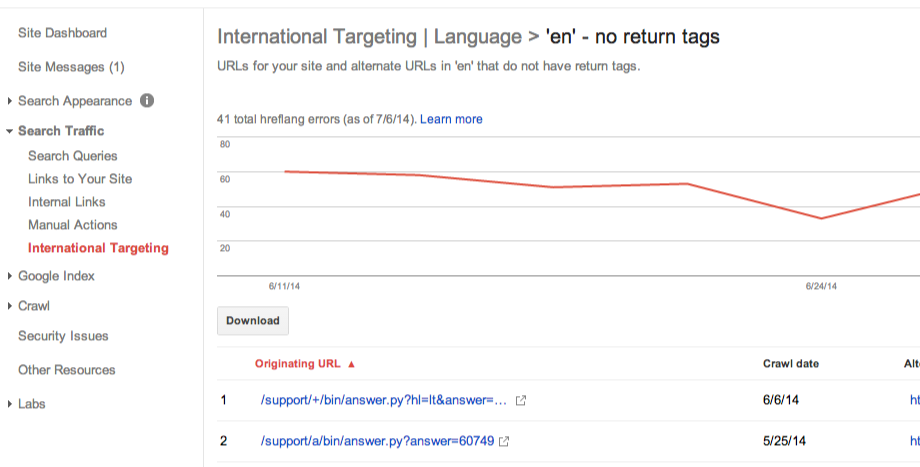
  • Missing return links: annotations must be confirmed from the pages they are pointing to. If page A links to page B, page B must link back to page A, otherwise the annotations may not be interpreted correctly.
    For each error of this kind we report where and when we detected them, as well as where the return link is expected to be.
incorrect_backlinks.png

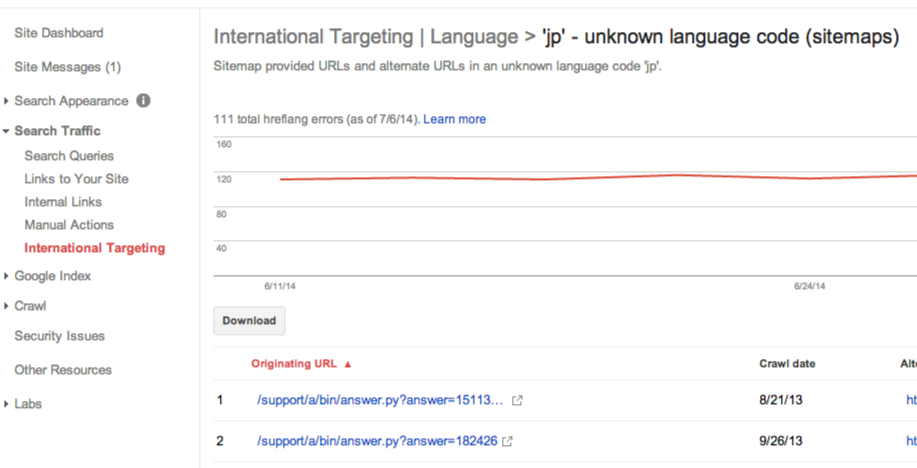
  • Incorrect hreflang values: The value of the hreflang attribute must either be a language code in ISO 639-1 format such as "es", or a combination of language and country code such as "es-AR", where the country code is in ISO 3166-1 Alpha 2 format.
    In case our indexing systems detect language or country codes that are not in these formats, we provide example URLs to help you fix them.

incorrect_language.png

Additionally, we've moved the geographic targeting setting to this part of Webmaster Tools, so that you can find all information relevant to international and multilingual targeting in the same place.

We hope you'll find this new feature useful and that it helps you to identify issues with the rel-hreflang-implementation on your site. If you have comments or questions about the feature, please post in our Webmaster Help Forum.

Posted by Gary Illyes, Webmaster Trends

Sunday, 13 July 2014

Google Friend Connect - Now in 47 new languages

Update: The described product or service is no longer available.


Have you been holding off on using Google Friend Connect because your site isn't in English? Starting today, Friend Connect is available in 47 new languages, including French, Italian, German, Spanish, Chinese, Japanese, Hindi and Portuguese. Now you can easily add social features that match the language of other content on your site.

Most Google-created gadgets (such as the members, comments, and recommendation gadgets) are now available in these new languages. Some developers have also created gadgets that support additional languages and we hope that there will be more to come in the future. To see a list of gadgets available in your language, visit the gadget gallery.

When you add Friend Connect to a new site, it will default to your primary language. But if your site is in another language, simply select it on the site settings tab and Friend Connect will automatically render the gadgets in that language. And if have multiple sites in different languages, you can select a different language for each of your sites.

To learn more or see the full list of languages, check out the Social Web Blog.

Webmaster Central YouTube update for July 6th - 10th

Want to see what's new on the Webmaster Central YouTube channel? Check out the answers to the latest Grab Bag questions:
Below is Matt's clarification about Google's use of the meta description tag:


Feel free to leave comments letting us know how you liked the videos, and if you have any specific questions, ask the experts in the Webmaster Help Forum.

Monday, 7 July 2014

Google Maps gadget: Help customers find their way

Webmaster Level: All

With the new directions gadget from Google Maps, any business can offer customized Google Maps directions to their business locations. With the directions gadget, you no longer need to type and update multiple sets of text directions. Let's face it: customers are only looking for directions from their specific location.

Last week, I looked up directions to the hotel in Sacramento that I had booked for the 4th of July weekend. As I had never been to that part of the state before, I was puzzled by the limited directions offered by their website - I had no idea whether I was approaching from the North, South, East or West or where the major highways were. What I needed were step-by-step directions from my exact starting point to the hotel that I could easily print and go.

Google has made this process easy for you. By copying and pasting a single line of code, any website can offer customized door-to-door directions powered by Google Maps to their users.


The gadget allows you to pre-fill the "To" field with one or multiple addresses. Customers are able to print their directions with a single click. And for those who prefer not to drive, the gadget also provides walking and public transit directions.


If someone enters a vague starting address, they have the option to specify a more exact address, which will then fly into the "From" field.


Providing directions from Google Maps is very flexible; in addition to run-of-the-mill addresses, you can give your customers directions to everything from a generic ZIP code to a specific set of latitude-longitude coordinates for any of your locations.

Example destinations:
123 River St, Woods, MA
90210
42.06782° N, 71.756963° W

You can also give your address an alias, or a name that everyone will understand. You can do this by putting the alias in parentheses just after the address:

42.06782° N, 71.756963° W (Grandma's House)


Take a look at how Legoland California, Emeril Lagasse, and Harvard University are using the gadget. And then test and create your own directions gadget here. For the many locations outside of the US, the gadget is available in 23 different languages.

Webmaster Central YouTube update for June 29th - July 3rd

Want to see what's new on the Webmaster Central YouTube channel? Check out the answers to the latest Grab Bag questions:
Do you run a small business? Check out Matt's tips on how to attract visitors on a small budget:


Feel free to leave comments letting us know how you liked the videos, and if you have any specific questions, ask the experts in the Webmaster Help Forum.

Sunday, 6 July 2014

HD958 (Dual SIM with 3G support)

Introduction

The so long waited dual SIM smartphones with 3G capabilities are now entering the market. One of the first of its kind is the HD958, from HOTWith the introduction of the low-cost Qualcomm MSM7227 chipset, it becames quite a feasible option for dual SIM smartphone manufacturers because it offers advanced processing and rich multimedia while supporting HSDPA/HSUPA for broadband data speeds over 3G networks.

As of today, HD958 runs Android OS, in its version 2.2 (Froyo), although it's announced that an update to version 2.3 (Gingerbread) will be released in the future.

Specifications

Chipset

Name:Qualcomm MSM7227
CPU:600 MHz ARM11™
GPU:Adreno 200
Instruction set:ARMv6

Software environment

Embedded:OS: Android 2.2.1 (Froyo)

Body

Dimensions
(width x height x depth):
118 x 61 x 12.8 millimetres
Weigth:147 grams
Color:Black

Battery

Capacity: 1850 mAh

Memory

RAM:capacity:512 MB
ROM-capacity:512 MB
Expansion slot:microSD memory card, supporting up to 32 GB

Network support

Primary phone:GSM850, GSM900, GSM1800, GSM1900, UMTS900, UMTS2100
Secondary phone:GSM850, GSM900, GSM1800, GSM1900
Data links:GPRS, EDGE, HSDPA, HSUPA

Display

Type:Sharp LCD capacitive touchscreen
Size:3.8 inches, WVGA resolution (480 x 800 pixels)

Camera

Main (rear):5 megapixels with autofocus
Secondary (front):0.3 megapixels

Interfaces

Bluetooth (802.15):Bluetooth 2.1 + Enhanced Data Rate
Wireless LAN / Wi-Fi (802.11):  IEEE 802.11b, IEEE 802.11g
USB:USB 2.0 Client, Hi-Speed (480 Mbit/s)
USB Series Micro-B (Micro-USB) connector

Satellite navigation

Built-in GPS module:SiRF III chipset
GPS antenna:Internal
Complementary GPS services:  A-GPS (Assisted GPS)

Additional features

Sensors:
Gravity, Proximity and Light sensors
Analog Radio:FM radio (87.5-108 MHz)

The phone...

This phone is also delivered with two batteries, or else it would not be a Chinese product... it also includes an earphone, wall charger, USB cable and a 2 GB microSD memory card.


The quality of materials seems to be good. I would prefer a different way of removing the cover as it is not easy to open and demands an extra care not to break the cover.


Although you can see the HTC logo on the back cover, this phone is not a HTC clone... or at least, any that I know of.


The connection to the charger / PC is not at the bottom, as usually, but on the lower right side, while the 3,5 mm headphone jack is on the top along with the power button.


It features four soft buttons (home, menu, back and search), which I personally like as there is not need to press hard to access that function.


Under the battery, you have access to the two SIM slots, as well as the microSD slot, thus the memory card is not hot-swappable. 


Display quality and touch-screen

I would say that the display used in this phone is of a great quality. Colors are much vivid, and due to the presence of a light sensor you can activate the automatic brightness control which may be a battery life saver after all. 


The display is capacitive, which means that you don't need to press the screen in order to do the action you want. The response to the touch is good and I don't have nothing to complain about that.


Functionality

Differences in the user experience with the HD958 are quite noticeable when compared to the HD9. The processor that is present on the used Qualcomm chipset behaves nicely, but the obvious and huge improvements are noticed in applications that require graphical processing (like games), due to hardware-accelerated 3D graphics.

The dual SIM integration is much like the HD9, just with some cosmetic changes, so there's no need to detail that.

One great feature present in Android 2.2 and enabled natively in this phone is the ability to share its mobile data connection not only via USB, but also as a portable Wi-Fi hotspot. Data connection can be easily shared with any other devices, anywhere. While a dual SIM phone is usually used for GSM calls on both SIM cards (for example, one for professional and another for personal use), with this feature and the support of broadband data connections, you can also have a SIM card with a dedicated data subscription and the other can be used for GSM calls.

One of the first tests I had to do with this phone was to establish an Internet connection, start surfing and check if I could receive a call on the other card. The test was partially successful... I say partially because the call can be received, which means that you won't get unreachable, but the data connection is broken. Only after the end of call, the data connection will be re-established. As you may know, there are not many dual SIM smartphones that let you establish a call on one SIM and have the ability to receive a call on the other. This phone is no exception, so while a call is being made in one SIM, the other will be temporarily "off" until the call ends.


User can also enable or disable data access over mobile network for each SIM, as well as other GSM/UMTS configurations.


As far as the GSM reception concerns, it seems to have improved in this phone. In the same spots that I normally had network breakdowns with the HD9, I don't have it any more with the HD958. During the past week I have never noticed the "restricted access changed" notification, so much common on the HD9. In terms of call quality it is pretty good, and people don't complain any more that the volume of my voice is too low.

One more thing that will make some people very happy is that Skype (version 2.0.0.45+) now works. In previous Chinese smartphones, Skype had a problem (although also present in many other branded Android smartphones), that would lead to an infinite loop during sign-in. 

Video review

Here's a video review:


Final thoughts

As already stated, the used processor makes the difference. I only wish that my HD9 had this processor, as I like its big screen. Nevertheless, this is a great phone and for some people, the 3.8 inch screen is the perfect dimension.

Highs:
  • Dual SIM Dual Standby with 3G support
Lows:
  • Lack of camera LED flash
  • Should have been released already with Android 2.3, although it will be updated in the future 

Wednesday, 2 July 2014

Requesting reconsideration using Google Webmaster Tools


If your site does not appear in Google Search results, you might be understandably worried. Here, we've put together some information to help you determine when and how to submit a reconsideration request for your site.

You can follow along as Bergy (the webmaster of example.com in our video) tries to find out whether he needs to submit a reconsideration request for his Ancient Roman Politics blog. Of course, not all webmasters' problems can be traced back to Wysz (-:, but the simple steps outlined below can help you determine the right solution for your particular case.


Check for access issues

You may want to check if there are any access issues with your site - you can do this by logging in to your Webmaster Tools account. On the Overview page you'll be able to see when Googlebot last successfully crawled the home page of your site. Another way to do this is to check the cache date for your site's homepage. For more detailed information about how Googlebot crawls your site, you might want to check the crawl rate graphs (find them in Tools > Set crawl rate).

On the Overview page you can also check whether there are any crawling errors. For example, if your server was busy or unavailable when we tried to access your site, you would get a "URL unreachable" error message. Alternatively, there might be URLs in your site blocked by your robots.txt file. You can see this in "URLs restricted by robots.txt". If there are URLs listed there which you did not expect, you can go to Tools and select "Analyze robots.txt" - there you can make sure that your robots.txt file is properly formatted and only blocking the parts of your site which you don't want Google to crawl.

Other than the examples mentioned above, there are several more types of crawl errors - HTTP errors and URLs timed out errors, just to name a few. Even thought we haven't highlighted them here, you will still see alerts for all of them on the Overview page in your Webmaster Tools account.

Check for messages

If Google has no problems accessing your site, check to see if there is a message waiting for you in the Message Center of your Webmaster Tools account. This is the place Google uses to communicate important information to you regarding your Webmaster Tools account and the sites you manage. If we have noticed there is something wrong with your site, we may send you a message there, detailing some issues which you need to fix to bring your site into compliance with the Webmaster Guidelines.

Read the Webmaster Guidelines

If you don't see a message in the Message Center, check to see if your site is or has at some point been in violation of the Webmaster Guidelines. You can find them, and much more, in our Help Center.

Fix your site

If your site is in violation of the Webmaster Guidelines and you think that this might have affected how your site is viewed by Google, this would be a good time to submit a reconsideration request. But before you do that, make changes to your site so that it falls within our guidelines.

Submit a reconsideration request

Now you can go ahead and submit a request for reconsideration. Log in to your Webmaster Tools account. Under Tools, click on "Request reconsideration" and follow the steps. Make sure to explain what you think was wrong with your site and what steps you have taken to fix it.

Once you've submitted your request, you'll see a message from us in the Message Center confirming that we've received it. We'll then review your site for compliance with the Webmaster Guidelines.

We hope this post has helped give you an idea when and how to submit a reconsideration request. If you're not sure why Google isn't including your site, a great place to look for help is our Webmaster Help Group. There you will find many knowledgeable and friendly webmasters and Googlers, who would be happy to look at your site and give suggestions on how you could fix things. You can find links to both the Help Center and the Webmaster Group at google.com/webmasters.